
Industry challenges
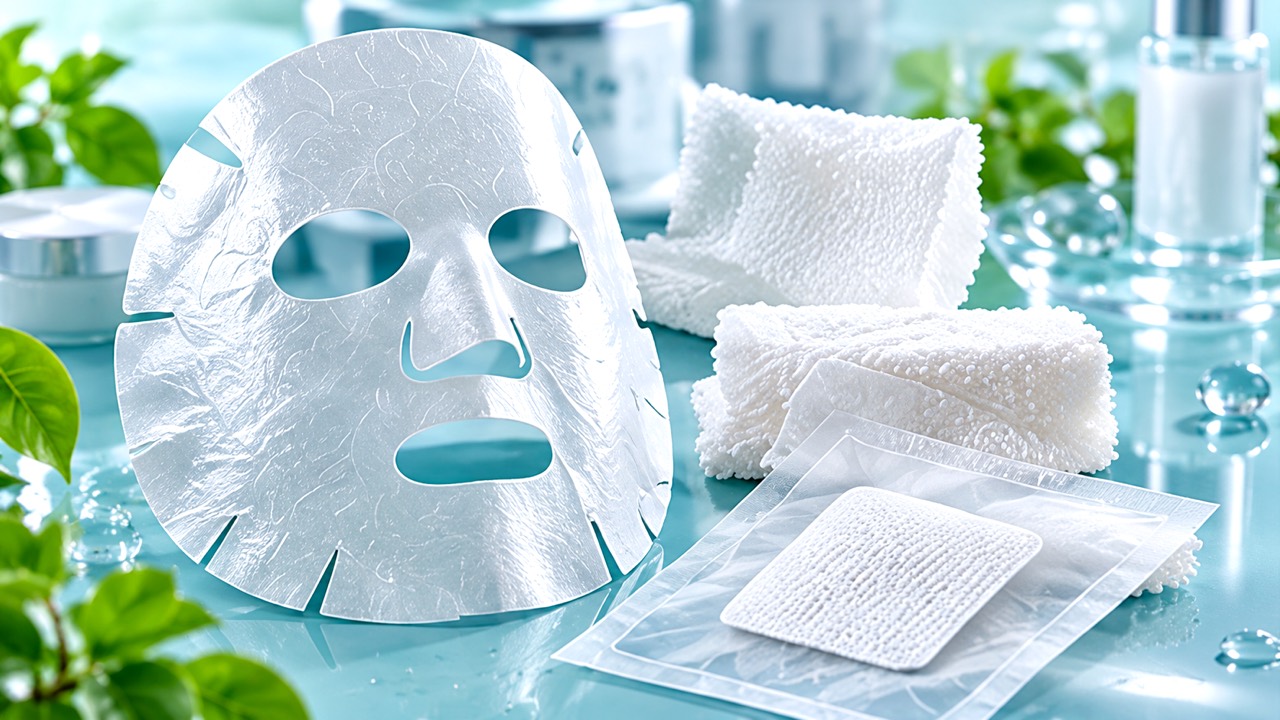
Wet dressings and face-mask substrates need high water content, conformability, integrity, liquid retention and comfort; medical use adds biocompatibility, sterilisation, microbial control and regulatory requirements. Treating an ordinary nanocellulose dispersion as a ready-made medical dressing is inaccurate.
What nanocellulose does
BC naturally forms a continuous three-dimensional nanofibre network that can be made into high-water-content gel membranes or dried membranes, suiting mask and dressing substrates; the network can further carry moisturising, active or functional components. CNF/CNC are better used as composite reinforcement or functional additives rather than replacing the complete membrane structure where a BC membrane already exists.
Recommended grade
Recommended: BC gel membrane and BC dry membrane.
Why: both already have a complete membrane form that maps directly onto masks and wet dressings. The gel membrane suits studies of high water content, conformability and loading; the dry membrane suits dry storage and transport, rehydration or secondary processing. BC dispersion is not the first choice here because it is positioned for cosmetic thickening and suspension.
Alternatives
Evaluate C-CNF or CNC as composite components when the interface, reinforcement or loading of a BC membrane needs tuning. BC dispersion remains a cosmetic rheology product and should not be mixed up with the membrane uses of gel and dry membranes.
Trial suggestions
For masks, compare BC gel membranes with rehydrated dry membranes on liquid content, conformability, tensile strength, wet integrity and compatibility with the essence. For dressings, add absorption, moisture permeability, wet mechanics and performance before and after sterilisation. Load functional liquids from low concentrations and confirm the membrane structure is not damaged.
Common issues
- Dry membrane deforms after rehydration: optimise drying and rehydration conditions.
- Gel membrane tears easily: check thickness and wet strength.
- Shrinkage after adding high-salt or active liquids: watch osmotic pressure and ionic interactions.
- Medical use requires separate biocompatibility, microbiological, sterilisation and regulatory validation; material properties alone do not make a medical claim.
Note
These suggestions are for nanocellulose material selection and preliminary trials only, not fixed formulations, final process parameters or regulatory conclusions. Results depend on product type, surface groups, solids content, dispersion state, dosing method, and on the system's pH, ionic strength, resin/polymer/protein type, pigments, fillers and other additives. Run a blank and a dosage gradient to confirm the grade and process conditions for your own system. For food, cosmetic, medical and food-contact uses, confirm regulations, purity, testing and market access separately for the target market.